 |
In addition to an individual e-book giveaway of THE TRANSLATOR on this blog, Nina is also
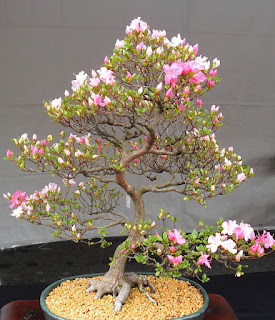
sponsoring a tour-wide Rafflecopter giveaway of THE TRANSLATOR and a packet of bonsai
seeds for the Japanese cherry
blossom, the blooms featured on THE TRANSLATOR'S cover. |
We’re fortunate today that Nina Schuyler shared an interview with us. Here's how she answers my questions:
Caroline: Where did you grow up? Were you considered a “bookworm” or a jock? Children?
Nina: I grew up in Washington state, on the west side of the Cascade Mountains, where the rain and heavy gray clouds are a constant, but everything's so green. That green, I think, is in my blood now. I'm always hunting for green--parks, hills, trails. And water. My childhood house was on a lake. There were four of us, four girls, and I was the second oldest. My older sister was gregarious and outgoing, always bringing friends home. I think I probably took a look at that life and chose, for whatever reason, to live mostly inwardly. I read and read and read, and my parents probably thought they' never get me out of the house. But when I was 11 years old, I discovered tennis and that became another obsession, which lasted through college.
I'm married now, with two thoughtful, kind boys and a wonderful, supportive husband who does his equal and fair share of parenting. He is my biggest fan.
Caroline: I was an introvert—really I still am. However, I’ve learned to cope with appearing in public and even speaking to groups and at conferences. Who are your favorite authors and favorite genres?
Nina: Oh, the list is long. I'm a sucker for great sentences, so I read and re-read Toni Morrison, Virginia Woolf, Joseph O'Neill, Colum McCann, Henry James, Cormac McCarthy, Melanie Rae Thon, Vladimir Nabokov, William Faulkner. Who else? I'd love to add to this list, so if anyone has suggestions! I usually read literary fiction, but I also read poetry.
Caroline: Oh, I'm a romantic, so I love THE COUNT OF MONTE CRISTO, LES MISERABLES, and Countess Borazky's tales of the Scarlet Pimpernel. In addition, these may be too contemporary or too light for you, but consider Kathryn Stockett’s THE HELP and Susan Elia Macneal’s Maggie Hope books set in WWII. I’m sure you’ve read TO KILL A MOCKINGBIRD. Obviously, I enjoy books that comment on our society in an entertaining way.
What’s your favorite way to relax and recharge?
Nina: I love to ride my bike. I live in a beautiful place, full of trees and coyotes that howl at night. I also love to paint. I don't do anything fancy, like buy canvases or even good paint. Only paper and tempura, so there's less pressure on creating something beautiful. It's really freeing to get out of the world of words.
Caroline: I love oils. I tried watercolor and enjoy that, but my weakness in drawing skills are better served by oils. Do you have a favorite quote that sums up how you feel about life?
Nina: Here's a quote about writing that is on my wall:
"A short story is a flower; a novel is a job."--Lorrie Moore.
Caroline: How long have you been writing?
Nina: I started writing late, I suppose. I was a big reader, and I think the reverence and awe that I felt for what writers could do on the page stopped me. Or at least made me doubt that I could ever create something worthwhile. I still have that awe, and I'm glad about that. I began writing through journalism, as a newspaper reporter. That job taught me to turn outward to the world, to be curious and ask questions and explore. I find that muscle is there in my fiction. For THE TRANSLATOR, I interviewed nine literary translators, to understand how they work, and read a great deal about translation theory.
Caroline: I also started in journalism, which is great for teaching the art of meeting a deadline and writing to a certain word count. Where do you prefer to write? Do you need quiet, music, solitude? PC or laptop?
Nina: Before children, I had a schedule and many restrictions about where and when and how. Now, with children, my writing life is much more fluid and pragmatic. If I'm in the middle of writing a novel (which seems to always be the case), I keep a notebook by the stove, while I cook. When I ride my bike, I carry a pen and small notebook and pull over, when something comes to me. Whenever I'm driving, that notebook is on the passenger seat. These snippets find their way into a story.
Caroline: Are you a plotter or a panzer?
Well, I had to look up "panzer" and I'm still not sure how to answer. I revise a lot. So it's two steps forward, five backwards. A sentence has to feel right before I move on. As a result, I'm slow, but I find that pace lets me digest what I've written, which spurs ideas and feelings for what comes next.
Caroline: A “panzer”, corrupted from “pantser”, as used here means someone who writes by the seat of the pants instead of planning and pre-plotting. Do you use real events or persons in your stories or as an inspiration for stories?
Nina: The idea for my first novel, THE PAINTING, came from a Japanese language lesson. My sensei had talked about ukiyo-e, the world of woodblock printing in Japan and how this form of art influenced European artists. After the lesson, I was driving home, imagining all this amazing artwork flying through the air, traveling the globe from Japan to Paris. It was this image, really, that began that book, thinking about what is the purpose of beauty? Of art? How does the east affect the west and vice versa? When you start this way, there is a lot of work to do to understand your characters.
For THE TRANSLATOR, in 2007 I read an article in The New Yorker, "The Translation Wars," by David Remnick about a married couple busy re-translating all the great Russian novels into English. It got me thinking about translation and the many books that I loved that had been translated. Growing up, I loved Russian literature, all of which was translated, of course. But silly me, I'd never really thought about that—how the story had to flow through an intermediary, ie, the translator. So whose story was I getting? The author's or the translator's? When you begin with an idea, you also have a lot of work to do to understand your characters.
Caroline: Do you set daily writing goals? Word count? Number of chapters? Do you get a chance to write every day?
Nina: My goal is to write every day. That said, when my sons were little, I was very kind to myself—write a sentence, I told myself. That is enough.
Caroline: What a clever way to vary with your schedule but still meet a goal and make writing a habit. What do you hope your writing brings to readers?
Nina: A certain delight that comes from getting under the skin of someone not quite like yourself. A chance to question and rethink what you've always thought was true.
Caroline: What long-term plans do you have for your career?
Nina: Keep writing, keep teaching creative writing.
Caroline: What advice would you give to unpublished authors?
Nina: After you've written a first draft of a story or novel, set the work aside for a couple days, a week, then re-enter it with new eyes. Find a writer's group and exchange work so you get another perspective on what's on the page. It's often not what you think. Find avid readers who will read your work and ask for honest feedback. Ask these readers (who aren't writers): where were you bored? What part did you skim? Those comments are valuable because here are the points in the story that can be cut or need more tension.
Caroline: Share a fun fact readers wouldn’t know about you.
Nina: As a young girl, I was called The Frog because I swam so much, my hair turned green from the chlorine.
Caroline: Share something about you that would surprise or shock readers.
Nina: When I was young, I loved garter snakes. We found them in my backyard, and I kept them in the little crawl space by the house.
Caroline: Is your book a series?
Nina: No, no series here.
Caroline: Can you give readers a blurb about your book?
Nina: Here's a blurb for THE TRANSLATOR:
When renowned translator Hanne Schubert falls down a flight of stairs, she suffers from an unusual but real condition — the loss of her native language. Speaking only Japanese, a language learned later in life, she leaves for Japan. There, to Hanne’s shock, the Japanese novelist whose work she recently translated confronts her publicly for sabotaging his work.
Reeling, Hanne seeks out the inspiration for the author’s novel — a tortured, chimerical actor, once a master in the art of Noh theater. Through their passionate, volatile relationship, Hanne is forced to reexamine how she has lived her life, including her estranged relationship with her daughter.
In elegant prose, Nina Schuyler offers a deeply moving and
mesmerizing story about language, love, and the transcendence of family. THE TRANSLATOR won the 2014 Next Generation Indie Book Award
for General Fiction and placed second for overall fiction. It was also
shortlisted for the William Saroyan International Writing Prize.
Caroline: I’ve heard about that amnesia condition, which must be frightening to the patient and his or her family. How about an excerpt?
Nina: Here's the opening of THE TRANSLATOR, in which Hanne is translating a novel written in Japanese.
Hanne sets down Kobayashi’s novel. The book did well in Japan, in part because Kobayashi revealed in an interview that his main character, Jiro, was inspired by the famous Noh actor, Moto Okuro. So intrigued, so fascinated was he by this remarkable man, that Kobayashi began the book right after he met Okuro.
“Moto cured five years of writer’s block,” Kobayashi told the magazine. “If he reads my book—and what an honor if he did—I hope he sees it as a homage to him.”
The name Moto Okuro meant nothing to Hanne, and she doesn’t know much about the ancient Japanese theater art of Noh, except masks are used for different characters, and the characters speak in a stilted, almost unintelligible language. There’s music to contend with, and almost like a Greek play, a chorus. She’d have to read Kobayashi’s Trojan Horse Trips herself first, on her own terms, she told the publisher. Only if she understood the main character would she be able to successfully translate the book into English. At her enormous blackboard, custom-made to take up one entire wall, she begins to write a sentence in Japanese.
Iradachi, the Japanese word for frustration. Of course you are frustrated, Jiro, thinks Hanne. You’ve brought your wife from one doctor to another, and more than a year later, there is no sign of improvement, no answers. You are in the same place you were three, five months ago. And what has become of your life? Turned into something unrecognizable, you no longer know who you are.
Caroline: An intriguing excerpt. Where can readers find your books?
Caroline: How can readers learn more about you?
Nina: I have a web site, www.ninaschuyler.com, and I'm on Facebook, with an author page and an individual page, and twitter, @Nina_Schuyler.
Caroline: Is there anything else you’d like readers to know about you?
Nina: You've asked excellent questions! I think you've covered it all. It's been a real pleasure.
 |
| Nina Schuyler, Author |
Nina Schuyler's
first novel, THE PAINTING, (Algonquin Books of Chapel Hill, 2004), was a
finalist for the Northern California Book Awards. It was also selected by the
San Francisco Chronicle as one of the Best Books of 2004, and dubbed a “fearless
debut” by MSNBC and a “great debut” by the Rocky Mountain News. It’s been
translated into Chinese, Portuguese, and Serbian.
Her short story,
“The Bob Society,” was nominated for a Pushcart Prize. Her poems, short stories
and essays have appeared in ZYZZYVA, Santa Clara Review, Fugue, The Meadowland
Review, The Battered Suitcase, and other literary journals. She reviews fiction
for The Rumpus and The Children’s Book Review. She’s fiction editor at Able
Muse.
She attended
Stanford University for her undergraduate degree, earned a law degree at
Hastings College of the Law and an MFA in fiction with an emphasis on poetry at
San Francisco State University. She currently teaches creative writing at the
University of San Francisco.
a Rafflecopter giveaway


 Tanzy Hightower has crossed the veil and entered the Unseen
world to fulfill the destiny she has at last embraced, to either seal or
destroy the veil between the Seen and Unseen worlds. She is the only mortal in
a land teeming with creatures who want her dead. To stay alive long enough to
stop Asher, the most powerful of the Unseen, Tanzy accepts his marriage
proposal and seeks refuge inside his palace.
Tanzy Hightower has crossed the veil and entered the Unseen
world to fulfill the destiny she has at last embraced, to either seal or
destroy the veil between the Seen and Unseen worlds. She is the only mortal in
a land teeming with creatures who want her dead. To stay alive long enough to
stop Asher, the most powerful of the Unseen, Tanzy accepts his marriage
proposal and seeks refuge inside his palace.


